Saturday morning,
wheels up.
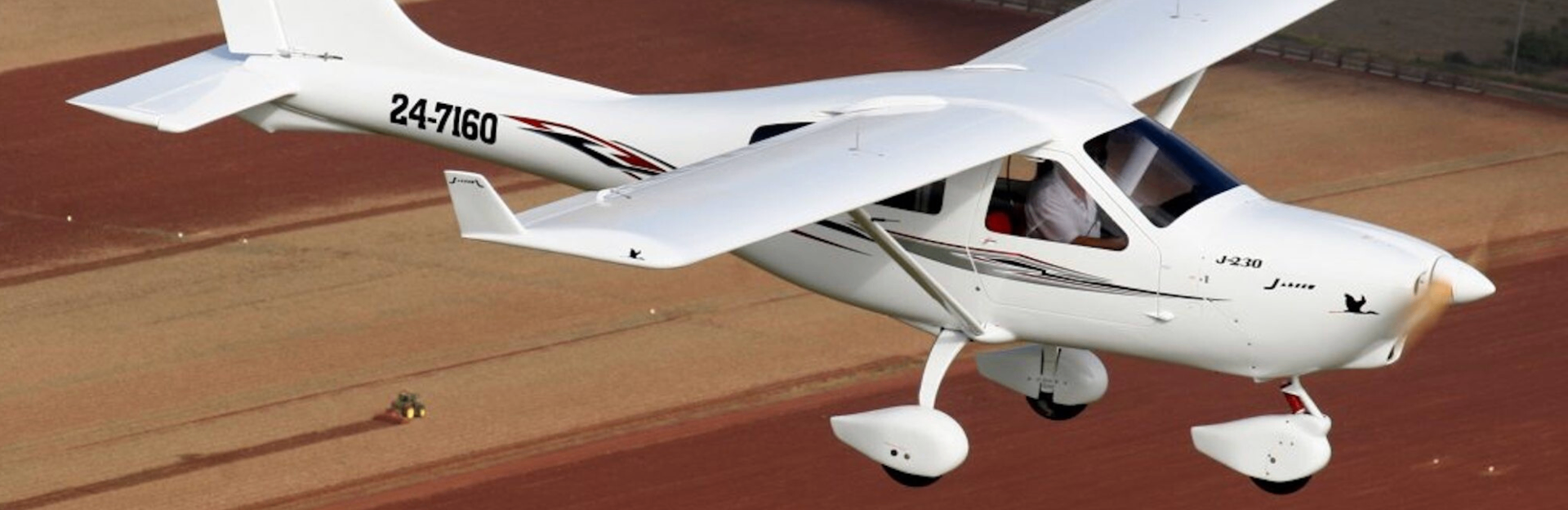
A modern you can actually fly often — driver's license medical, hangared, ready.
120 knots true at 5 gallons an hour. Glass panel, autopilot, ADS-B. Built for $100 hamburgers and weekend trips, not for filling out medical paperwork.
eligible · Glass panel · Always hangared
Recreational flying without the headaches.
No medical paperwork.
The Light Sport J230 and J250 are Light Sport. Pilot rules apply: your driver's license is your medical. No third-class medical certificate. No BasicMed paperwork. No medical examiner waiting room. If you can drive, you can fly.
$40 hamburger trips.
At 5 GPH cruise burn, an hour of recreational flying costs $35 in fuel. A typical lunch run to a $100-hamburger field — maybe 90 minutes round trip — costs you $52 in fuel. Compare to a 9 GPH Cherokee: $94. The Light Sport is the airplane that makes the $100 hamburger an actually-$100 hamburger.
Hangared, modern, ready.
When you decide Saturday morning that you want to fly, the airplane is fueled, hangared, and ready. Glass panel. ADS-B. Autopilot for the long legs. No discovering a flat tire at 8 AM. No waiting on parts. A multi-airplane fleet means backup is real, not theoretical.
What a year of recreational flying actually costs.
Most recreational pilots fly 40–60 hours a year. That's roughly one Saturday morning a month, a long weekend or two, and a handful of evening pattern sessions to stay current. Here's what that looks like at A4 vs. the legacy options.
| Annual pace | A4 Light Sport wet (all-in) | Cherokee 140 dry + fuel | Cessna 182 dry + fuel |
|---|---|---|---|
| 40 hours/year | $5,400 | $5,120 | $8,920 |
| 60 hours/year | $8,100 | $7,680 | $13,380 |
| 100 hours/year | $13,500 | $12,800 | $22,300 |
Comparison assumes $7/gal 100LL for Cherokee and Cessna. Cherokee at $65 dry + 9 GPH. Cessna 182 at $125 dry + 14 GPH. A4 Light Sport J250 at $135/hr wet — fuel included, no receipts.
What you keep
A modern airplane, current panel, no medical paperwork — for roughly what a 1970s Cherokee costs to fly.
The difference is what you're flying. The Cherokee owner is paying 1978 prices for 1978 capability. You're paying 2026 prices for 2026 capability. At every utilization level, modern wins on dollar value — and on what you're actually doing with the airplane.
Where the airplane can actually take you.
Denton Enterprise (KDTO) sits in the upper edge of the DFW metroplex. A Light Sport J250 with full fuel and a single pilot has roughly 6 hours of endurance and 800-nm of range. That puts a lot of weekend destinations comfortably inside one-tank reach.
Day trips
- •Stephenville (KSEP) — $100 hamburger at the Hard Eight BBQ patch
- •Mineral Wells (KMWL) — easy practice patterns, scenic approach
- •Granbury (KGDJ) — lakeside lunch, weekend ramp scene
- •Stinson Field (KSSF), San Antonio — long day trip, 90 minutes each way
Weekend trips
- •Hot Springs (KHOT), Arkansas — scenic flight, two-tank one-way
- •Galveston (KGLS) — beach weekend, one-tank one-way
- •Carlsbad (KCNM), New Mexico — caverns, one-tank with reserve
- •Oklahoma City (KOKC) — easy 90-minute hop
Once-in-a-while runs
- •Big Bend / Marfa (KMRF) — Texas high desert, two-tank
- •Santa Fe (KSAF) — long weekend, easy two-leg trip
- •Eureka Springs (KEUH), Arkansas — Ozarks weekend
- •Padre Island via KCRP — beach reset
The Fuel Math
The math that makes recreational flying still make sense in a $7-fuel world.
The math hasn't changed — the price of fuel has. A 9 GPH airplane at $7 avgas is a $63-an-hour fuel bill before the engine starts. A 100-hour year is $6,300 in fuel alone. That is why used Cherokees and 172s are sitting on ramps from Dallas to Detroit.
Our modern fleet burns 5 GPH. That is $35 an hour in fuel. $3,500 a year. That efficiency is what lets us quote a low all-in wet rate — $135/hr on the J250, $150/hr on the J230 — with fuel included. One number covers the airplane and the gas. No receipts, no reimbursement paperwork, no surprises at unfamiliar FBOs. You know what an hour costs before you preflight.
Comparison assumes $7/gal 100LL across all three aircraft. These are fuel costs only. A4 Aviation's Light Sport rates are wet, so members never see a separate fuel bill — the low ~5 GPH burn is what lets us quote a low all-in wet rate.
Frequently asked questions from recreational pilots.
Do I need a medical to fly the aircraft?
No third-class medical and no BasicMed required. The Light Sport J230 and J250 are Light Sport. Pilot rules apply — a valid US driver's license is your medical for pilot operations. If you already hold a private certificate, you can also exercise privileges in the J250 without a medical.
What if I'm not a pilot — can I still fly the aircraft?
Yes. Private and higher certificates can fly the aircraft under privileges (no medical required) or under their higher certificate privileges (medical required for higher operations). Most recreational private pilots simply exercise privileges in the aircraft and skip the medical.
Can I take friends and family?
The Light Sport J230 and J250 are two-seat aircraft. One pilot, one passenger. Pilot privileges allow you to carry one passenger. For four-seat needs, A4 does not currently operate a four-seat aircraft — but the J250 is more than enough airplane for the vast majority of recreational flying.
Can I fly at night?
Pilot privileges do not include night flying. Private pilots flying the aircraft under their private privileges with a current medical may fly at night if the airplane is night-equipped — confirm specific airplane equipage with dispatch before booking a night flight.
How does scheduling work?
Online booking with real-time availability. Members can book up to 60 days in advance. Standard reservations are released for the next day until midnight. Weekend mornings book first — book early for Saturday and Sunday flights.
What if weather cancels my flight?
No-fly-due-to-weather cancellations are no-charge if cancelled before the reservation window. We don't charge cancellation fees for legitimate weather calls. We'd rather have you fly safe than fly stressed.
Where is A4 Aviation based and how do I get there?
Denton Enterprise Airport (KDTO) in Denton, Texas. Roughly 30 minutes from most DFW metro neighborhoods. Free hangar parking for your car while you fly. Open ramp.
Start flying for fun again.
Membership, checkout, and your first $100 hamburger run can be booked in two weeks. The airplane doesn't require a medical. The fuel bill doesn't require a second mortgage. Just decide to fly.
The fun math
$40 hamburger runs
5 GPH cruise · Glass panel · No medical · KDTO
(214) 509-8456
info@a4aviation.co
Sheltair FBO · KDTO · Denton, Texas